Salinas da Margarida, Bahia de Todos os Santos — 5 July 2019
The name tells the story: salinas means salt pans, and this small town on the eastern shore of the Bahia de Todos os Santos built its identity on a commodity that once defined wealth in colonial Brazil. Salt preserved the meat and fish that fed the interior, sustained the plantation economy, and was taxed as fiercely as sugar. The shallow tidal flats along this stretch of coastline were ideal for evaporation ponds, and for centuries the white crystals that came out of them found their way onto the tables and into the trade ledgers of Salvador across the water.
When industrial production made the local salinas obsolete, the town simply stayed. What remained was the calçada — a waterfront promenade paved in the traditional Portuguese black-and-white stone mosaic, with "SALINAS" spelled out in the cobbles in letters large enough to see from a passing boat. A row of open-air restaurants lines one edge of the promenade under a corrugated roof, with plastic tables, cold beer, and moqueca made from whatever came out of the bay that morning.
The parish church stands at one end of the waterfront, a building of the eclectic early-20th-century style that Bahian towns favour — part baroque, part neoclassical, entirely exuberant, with a single central spire flanked by smaller towers, each niche filled with a saint. Nossa Senhora das Candeias holds her candles inside. The feast of the Candles on February 2nd is also the day of Iemanjá in the Candomblé calendar, when Bahians bring flowers and miniature boats to the sea for the goddess of salt water. A town built on the bay, named for what the sea leaves behind when it evaporates — Salinas da Margarida seems a fitting place for that doubling of devotions.
We anchored off the waterfront in the afternoon. At low tide the beach revealed a crowd of colourful wooden fishing boats pulled up on the sand — reds, greens, blues — in the high-gloss paints Bahian fishermen favour. We walked the calçada, ate moqueca at one of the covered restaurants, and watched the town going about its Friday. By golden hour we were back aboard, Yuka stretched out on the trampoline with a book, the church spire catching the last light across the flat water.
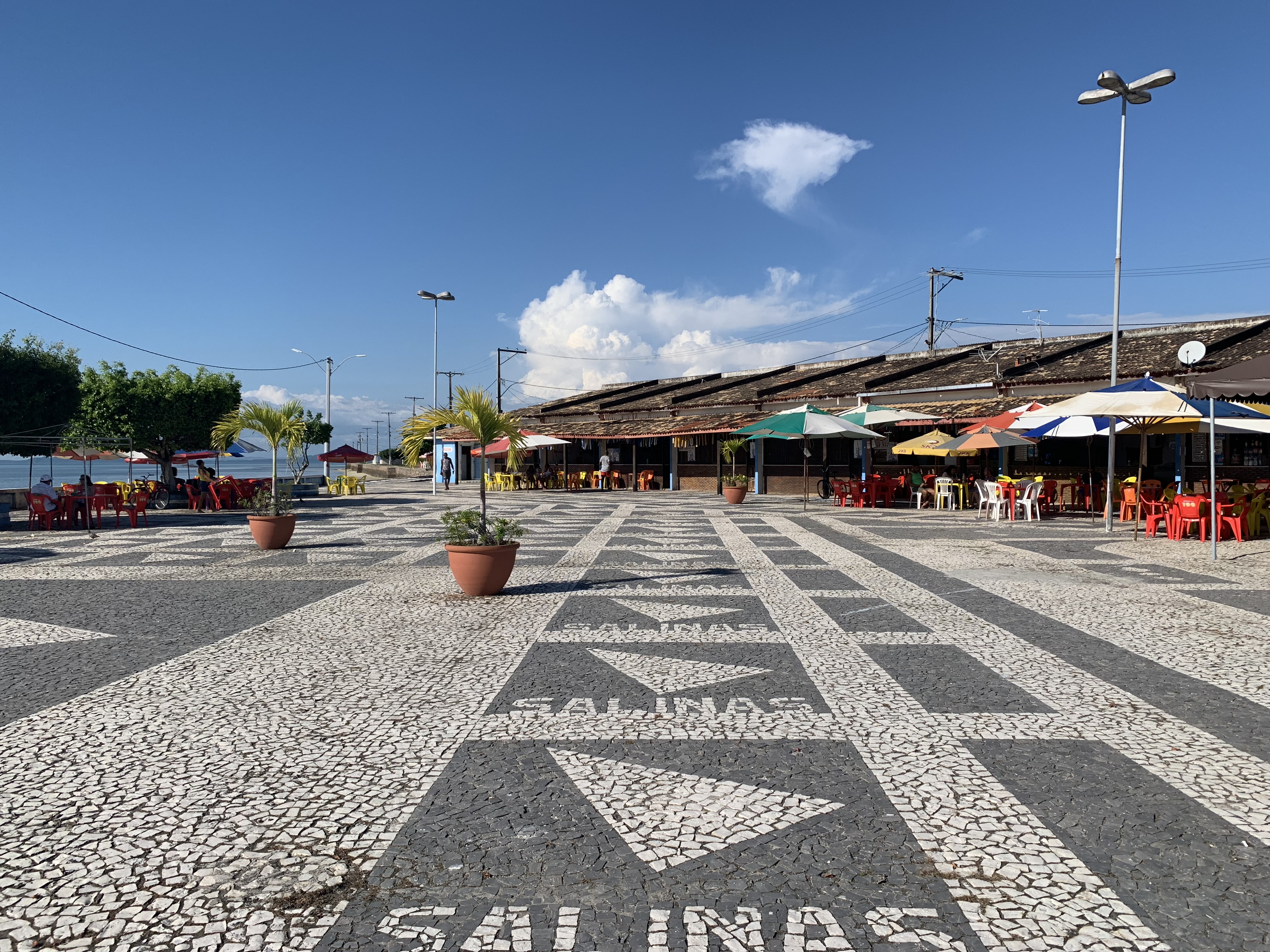
The waterfront calçada — black-and-white stone mosaic with "SALINAS" spelled in the cobbles, and a row of moqueca restaurants behind
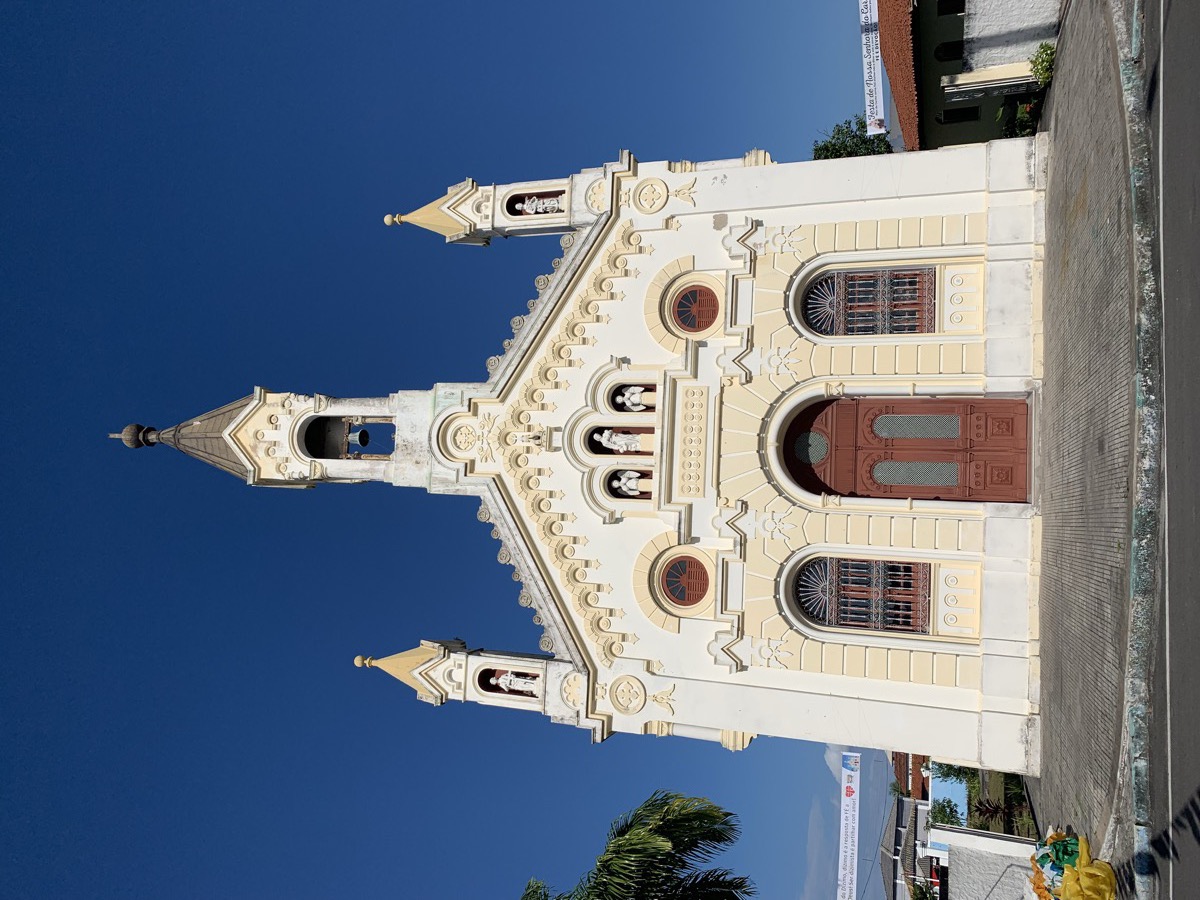
The parish church — eclectic early-20th-century facade, baroque in spirit, with a saint in every niche
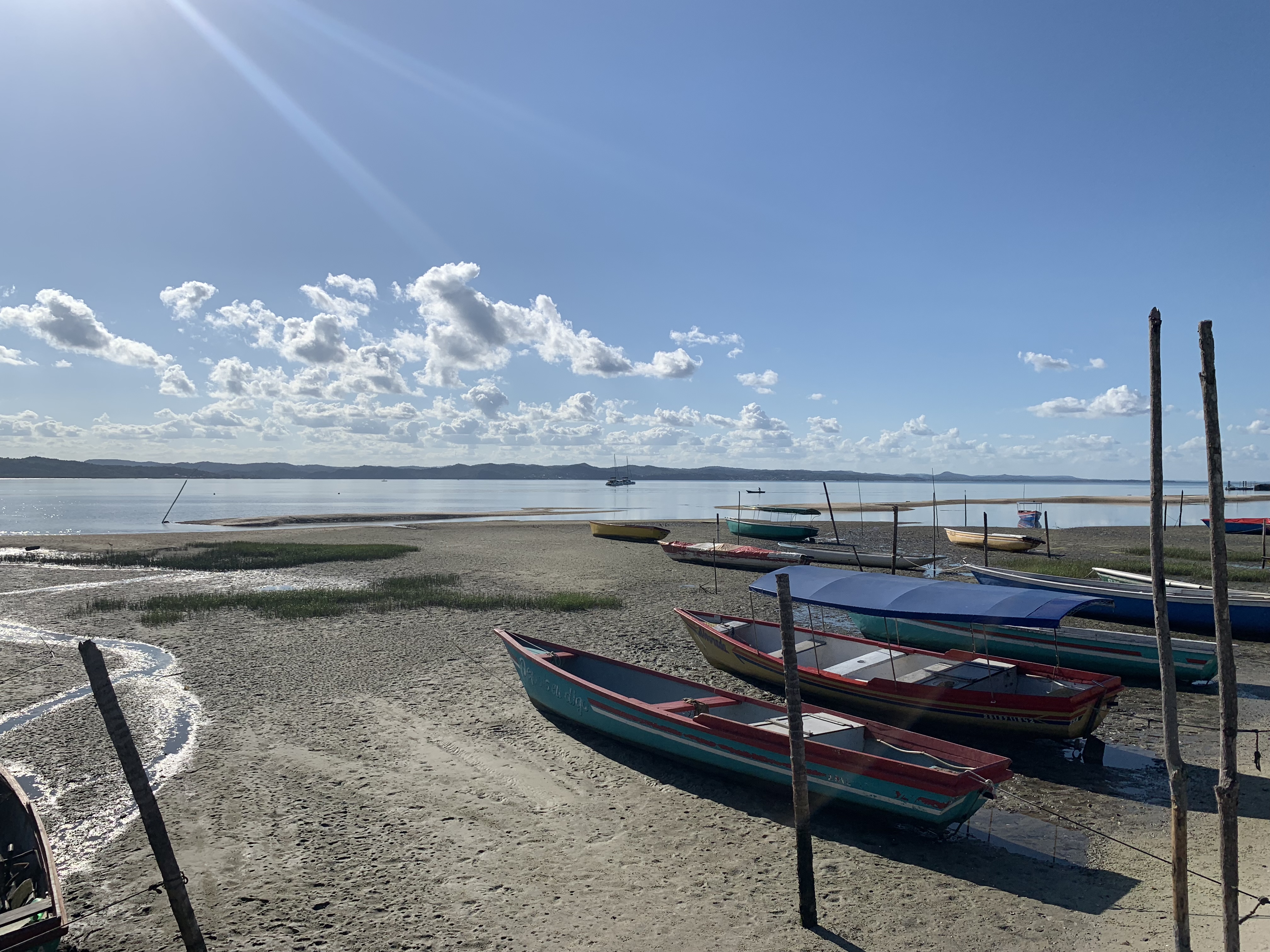
Low tide at the fishing beach — traditional wooden bateiras in the high-gloss reds and greens that Bahian fishermen favour, with Oroboro at anchor beyond
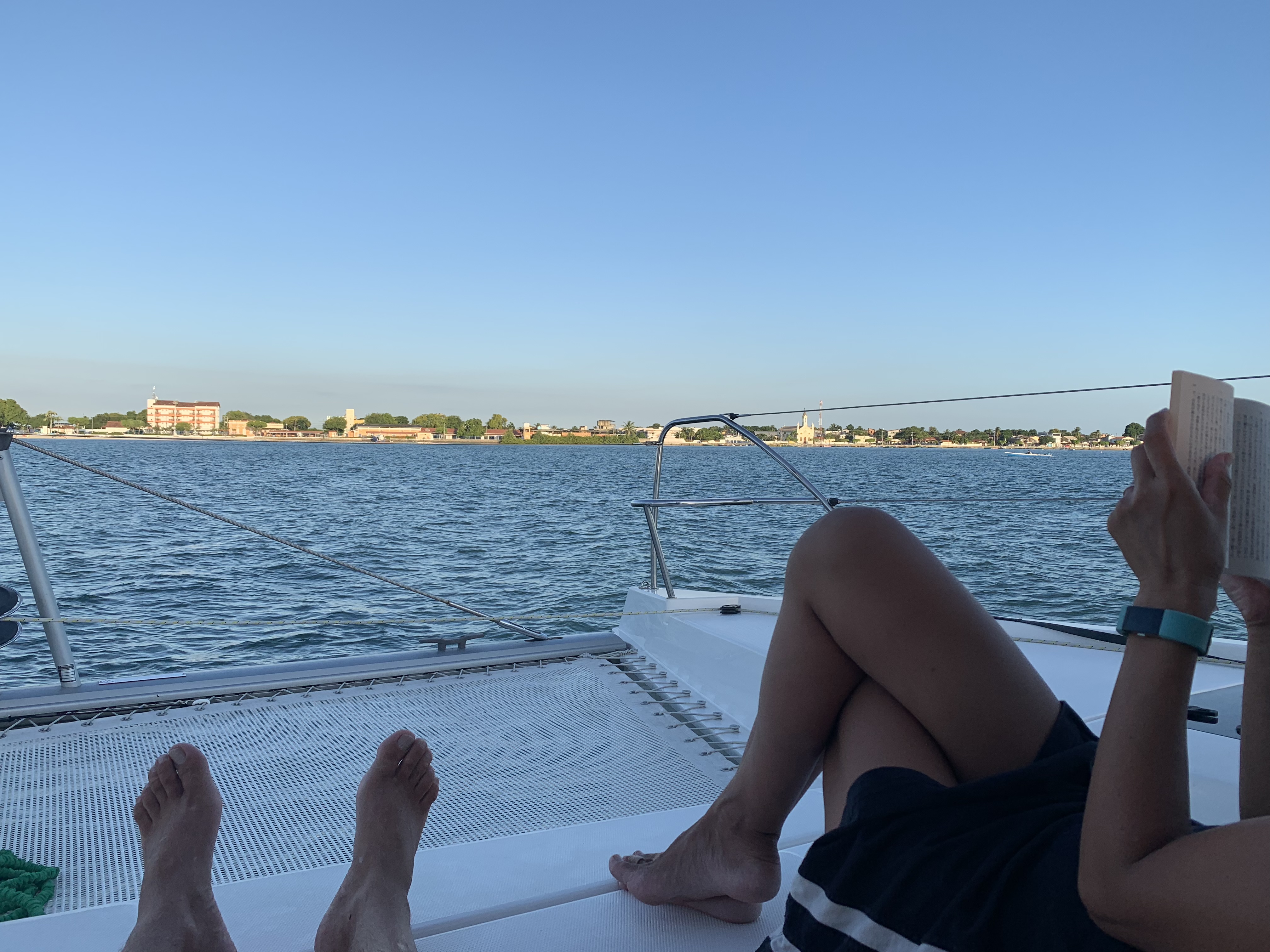
Golden hour at anchor — Yuka reads on the trampoline while the town and its church spire glow across the bay