South Atlantic Ocean, January 2019
We were ten days out of St Helena, somewhere deep in the South Atlantic with no land in any direction for over a thousand miles. The ocean had been empty for so long that we'd almost stopped expecting anything else. Just Oroboro, the swells, the trade wind, and the stars.
Then the VHF crackled.
A voice — warm, with a distinctive Hungarian-American accent — came through on Channel 16. He'd spotted us on AIS and called us up. He introduced himself: Istvan Kopar, sailing Puffin, competing in the Golden Globe Race.
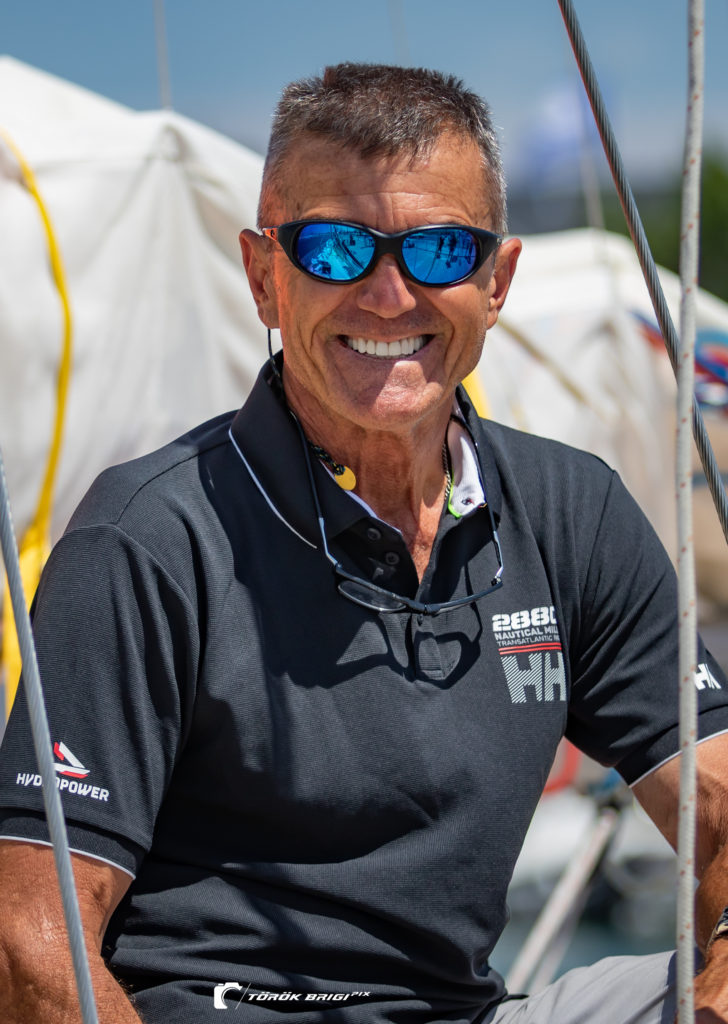
Istvan Kopar — solo circumnavigator, Golden Globe Race 2018. Photo: koparsailing.com / Török Brigitta
In the middle of the ocean, on a random morning in January, we were talking to a man who had left France six months earlier and was now somewhere around Day 200 of a solo non-stop circumnavigation.
The Golden Globe Race
The Golden Globe Race is a recreation of the original 1968–69 Sunday Times race — the one that made Robin Knox-Johnston a legend and launched the era of solo offshore sailing. To race in the modern GGR is to go back in time: no GPS, no satellite phone, no chart plotter, no email. Navigation by sextant and paper charts. Self-steering by wind vane only. Communication by SSB radio. The boats must be classic designs built before 1988.
The 2018 edition started on July 1st from Les Sables-d'Olonne in France. Eighteen sailors set out on the clipper route: south past the Cape of Good Hope, across the Southern Ocean, around Cape Horn, and back north through the Atlantic. Roughly 30,000 miles, alone, in the old way. Only five would finish.
Istvan had rounded Cape Horn on New Year's Day — January 1st, 2019. He told us he had scattered his father's ashes there.
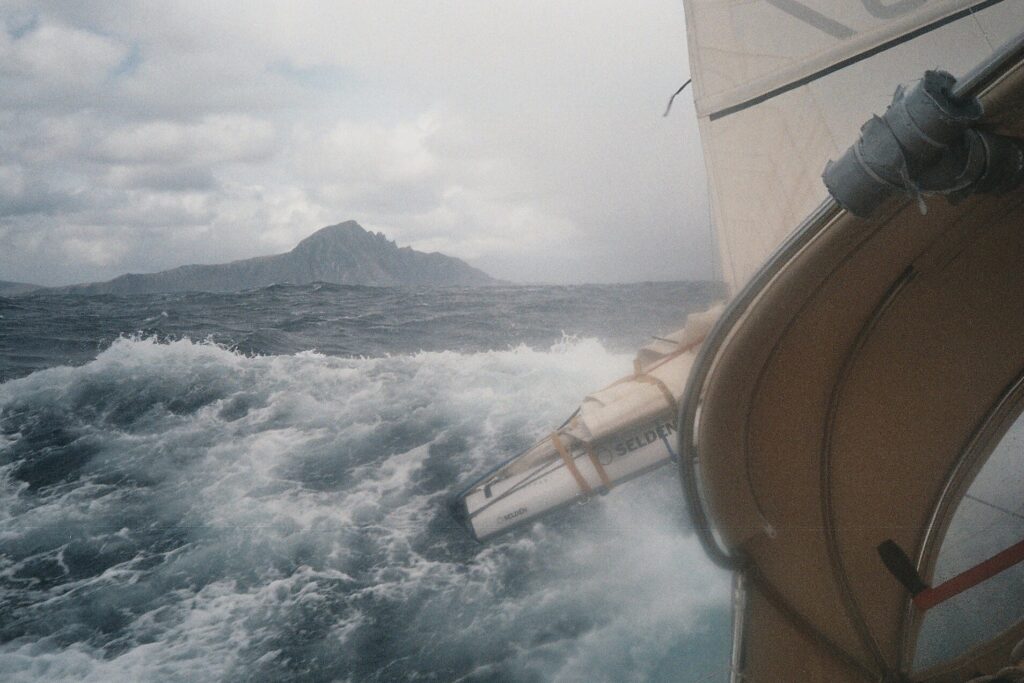
Cape Horn from Puffin's deck — Kopar rounded the Horn on New Year's Day, just weeks before we crossed paths. Photo: koparsailing.com
I filmed the radio exchange on my phone. You can watch it below — grainy and low-fi, with subtitles because the radio compresses voices into something halfway between a human and a kettle. But listen past the static and you can hear it: two crews, in the middle of the Atlantic, finding each other by chance.
Our VHF radio exchange with Istvan Kopar aboard Puffin — somewhere in the South Atlantic, halfway through his circumnavigation
Ships that pass
The ocean is immense, and the chance of two small sailboats being within VHF range of each other — roughly 25 miles — anywhere in the South Atlantic is vanishingly small. That we happened to be there, on that particular morning, heading in opposite directions across the same stretch of water, still feels like something.
We talked for maybe twenty minutes. He told us about the steering problems that had plagued him since the early days of the race, about the repairs he'd made at sea, about Cape Verde where he'd almost stopped. About Cape Horn on New Year's Day, alone at the bottom of the world. He asked about our crossing, where we'd come from, where we were heading.
Then he mentioned water. GGR boats carry no watermaker — the rules forbid modern technology, so skippers depend entirely on rain to replenish their drinking supply. It hadn't rained in a long time, and Istvan was running low.
We had our own water problems — our watermaker had broken down days earlier and we were rationing too — but we offered anyway. It felt like the only human thing to do: two boats alone in the ocean, one of them thirsty.
He thanked us and declined. Accepting water from another vessel would disqualify him from the race. After 200 days at sea and 30,000 miles still to count, he wasn't going to let that happen over a jerrycan of water. He'd wait for rain.
And then we said goodbye and the radio went quiet and the ocean was empty again, each of us continuing in our own direction. His: north toward the equator, then France. Ours: west toward Brazil.
Our tracks crossing in the South Atlantic: Oroboro (blue) westbound from St Helena to Brazil; Puffin (orange) northbound after rounding Cape Horn (×) on New Year's Day
Istvan Kopar finished the Golden Globe Race on March 21, 2019, in fourth place — 263 days after leaving France. Of the 18 who started, only 5 finished. Jean-Luc Van Den Heede, 73 years old, won it.
It is worth pausing on what the Golden Globe Race is, and what it is not. Its spiritual twin — and polar opposite — is the Vendée Globe: also solo, also non-stop, also around the same three capes. But the Vendée Globe is sailed on IMOCA 60 foiling machines bristling with satellites, autopilots, and onboard computers. Armel Le Cléac'h won the 2016 Vendée Globe in 74 days. The GGR winner in 2018 took 211. Same ocean. Same capes. The difference between the two races is the difference between a Formula 1 car and a 1960s rally racer with the windows down — one is about what technology can do, the other is about what a person can endure.
We thought about that a lot in the months that followed. And then, a few weeks after arriving in Rio de Janeiro, a beautiful blue racing yacht quietly slipped into the berth next to ours at Marina da Glória. It was the Hugo Boss IMOCA 60 — skippered by Alex Thomson, who had finished second in the very Vendée Globe we'd just been talking about. Two encounters, two races, two completely different visions of what it means to sail alone around the world. That story is here.
You can follow Istvan's sailing at koparsailing.com. He is still out there.