Today marks the end of the 3rd consecutive week since we took ownership of our boat here in Cape Town. We have been working hard to install all the systems we need, taking only one Sunday off out of three to relax and decompress. Practically, we spent these 3 weeks supervising the installation of the electrical systems we designed. Electricity is crucial when you live off the grid.
In a marina, the shore power cord acts as an umbilical cord: AC power is the primary energy source and its availability is more or less unlimited. At sea, in the absence of a constant AC source, the DC system becomes primary — and its availability is strictly limited by your battery capacity and the charging power of your alternative sources, like solar. The DC system is rarely tested at the docks to see if it has the necessary capacity. All too often, once away from the docks the DC system crashes or you simply don't have enough power. This is the #1 problem on cruising boats.
That's why the electrical system was item #1 on our to-do list. Here is what we carried out during our first three weeks on board:

Battery Charger and Primary Inverter
As battery charger and inverter we installed the Victron MultiPlus 12/3000/120. When connected to shore power in a marina it charges our batteries. At sea it converts DC current from the house batteries into AC so we can run power-hungry devices like the washing machine. Victron is cutting-edge technology and the MultiPlus is the heart of our electrical system.

Secondary Inverter
Even with no loads switched on, the big MultiPlus draws at least 4 amps in standby — a constant drain at sea. To solve this we installed the Victron Phoenix 12/375 VE.Direct, a small inverter that stays on permanently, connected to one dedicated outlet for charging laptops and anything that can't run from USB.

Control Unit
To monitor everything and stay on top of our systems we installed the Victron Venus GX. We can connect to it from our phones via Wi-Fi and have the full picture at our fingertips. It also logs all energy data to the Victron VRM cloud portal, which is invaluable for understanding our usage patterns.
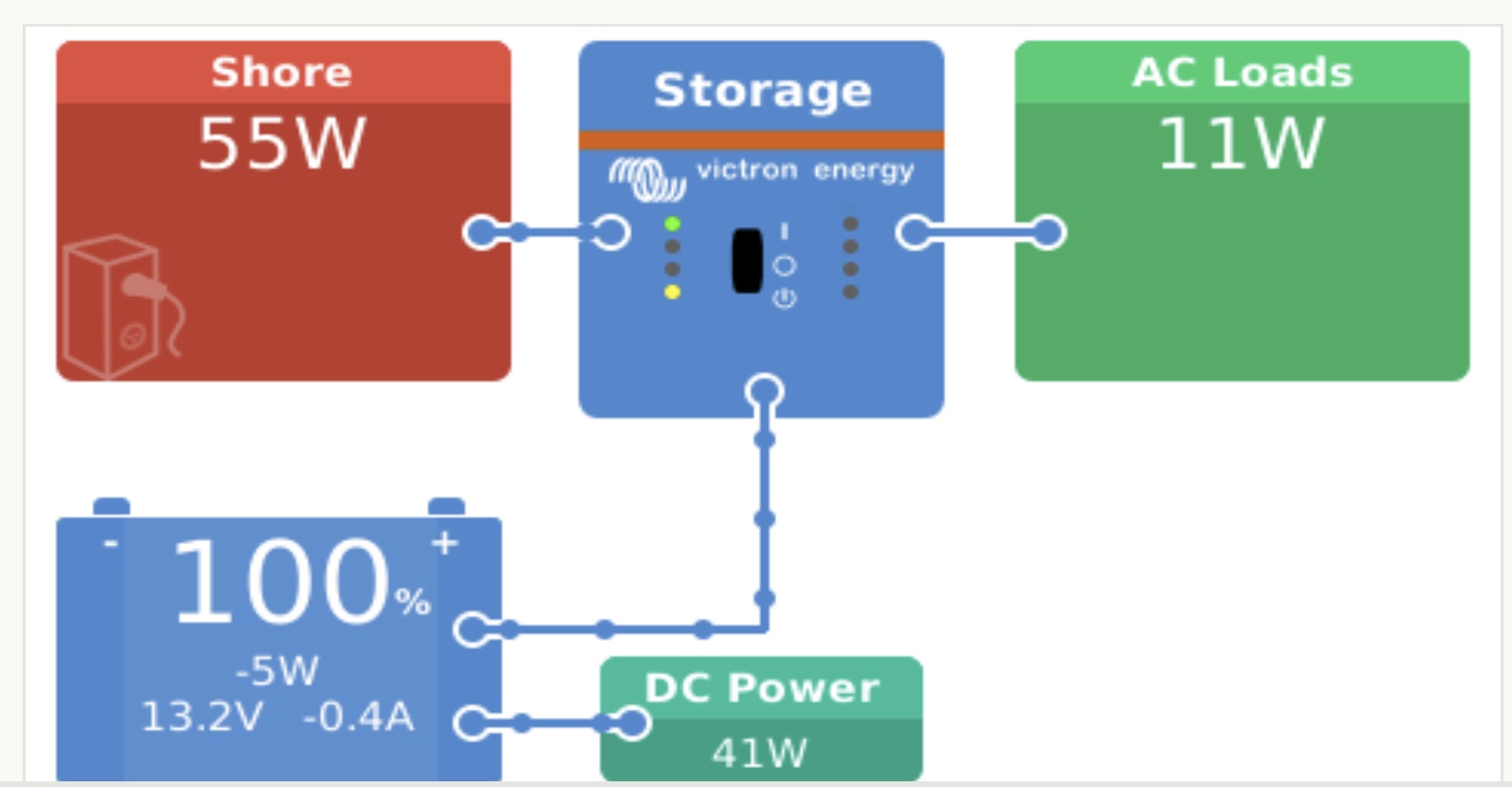
The Venus GX UI shows live power flows. Solar panels not connected yet — once they are, you'll see exactly how much is coming in and going out.

Battery Monitor
The Victron BMV-712 Smart is the instrument panel for our battery bank. It shows voltage, current, power, amp-hours consumed, state of charge, and remaining time at the current discharge rate — all at a glance, or via Bluetooth on a well-designed app. You can set alarms or configure a relay to automatically shed non-critical loads. It also logs historical data to help evaluate usage patterns and battery health.

Alternator to Battery Charger
The Sterling Pro Alt C E13 lets us charge our batteries up to 5× faster using the engines — a critical backup when solar is insufficient, or during passages with prolonged overcast skies. It also has temperature sensors for both the battery and alternator. It works as a sophisticated DC-to-DC converter: by dropping the voltage on the supply side, it forces the alternator to deliver the maximum current the battery can accept.
That covers power management. We also installed two major power-consuming systems:

Air Conditioning
We installed a 12,000 BTU Dometic CruiseAir, which doubles as a heater with 3,500W heating capacity. It's a 230V system drawing roughly 1,000W. We'll likely only need it in a windless marina on shore power, or in the tropics when we can't leave the hatches open at night due to rain — in which case a portable Honda generator on deck would power it. We also installed an EasyStart soft starter to ease the motor startup load.

Watermaker
When you live off the grid, making your own fresh water is essential. We chose the Spectra Newport 400 with Z-Ion for its remarkable efficiency — as little as 15 watts per gallon (4 watts per litre) — which means we can run it directly off the battery bank. Automated and easy to use, it makes us completely self-sufficient for water. We'll never need to pull into a marina just to fill the tanks. We were thrilled to drink that very first glass of water we produced ourselves.
Finally, a critical piece of navigation electronics. Our radar was installed at the factory, but we added one more essential item:

AIS Transceiver
An AIS transceiver is one of the most important safety devices on a sailboat. You not only receive position broadcasts from other vessels — you also transmit Oroboro's own information, making us visible on every other ship's radar and chart plotter. Paired with the radar, it's a formidable collision-avoidance system. Since all our navigation electronics are Raymarine, we went with the new Raymarine AIS 700.
Three weeks' worth of work, including Saturdays and sometimes Sundays. There are still a few things left to do: we're building a stainless steel structure to support three 320W solar panels, and adding five flexible panels on the bimini roof. We've already done the first dry fit for the structure — we found a small shop in Cape Town that does wonders with stainless steel!
Hopefully the solar structure will be finished by the end of week four. Then we'll finally take some time off the boat and explore the country.
We haven't seen much of Cape Town yet, but what little we've seen is spectacular. Looking forward to discovering more of this beautiful city and country!