Marina da Glória, Rio de Janeiro, 4 March 2019
We had been in Rio for about a week, riding out Carnival aboard Oroboro at Marina da Glória. It was early evening, the light going golden over the bay, when a black boat motored slowly into the marina and began manoeuvring toward the empty berth right next to ours.
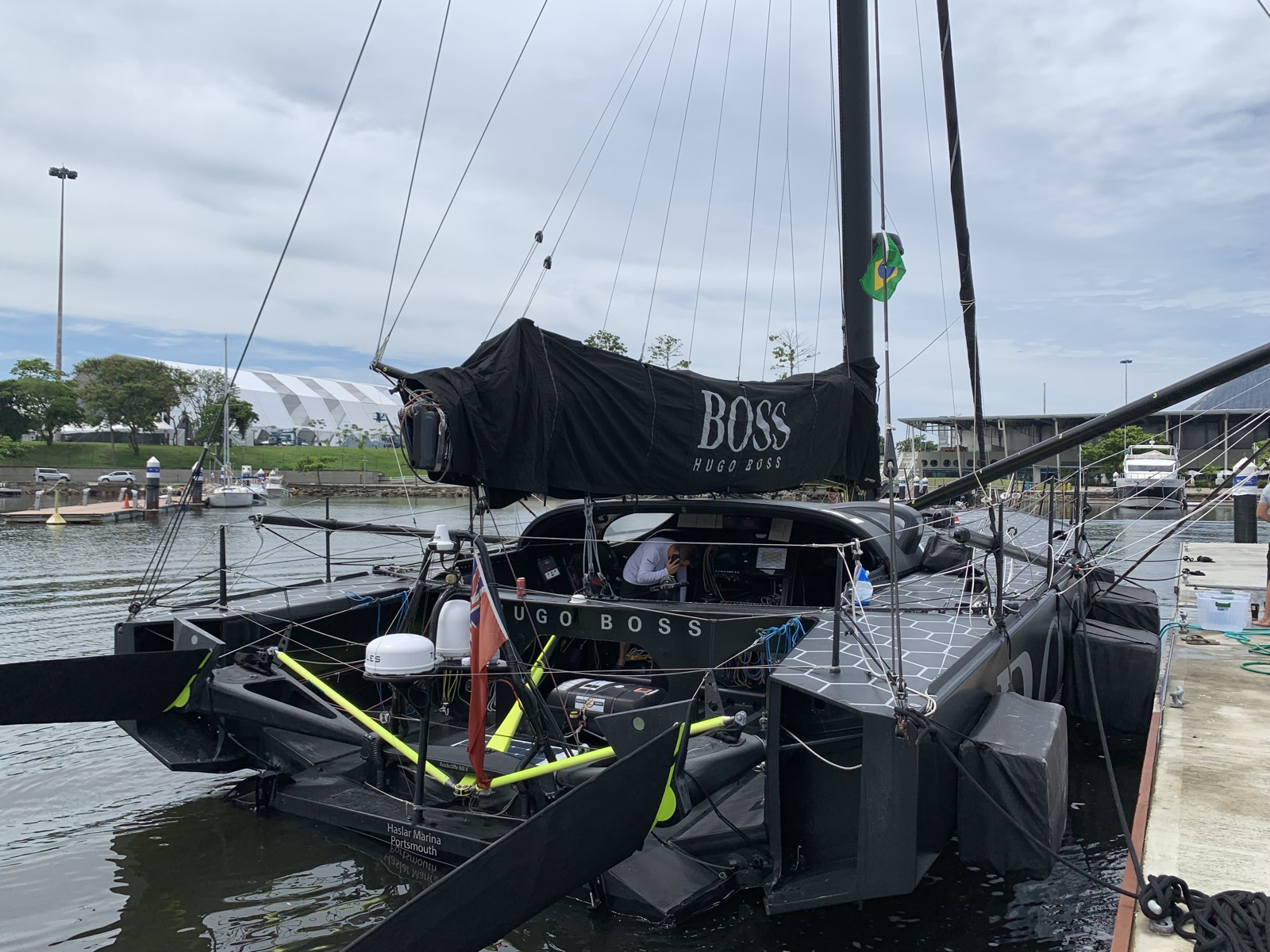
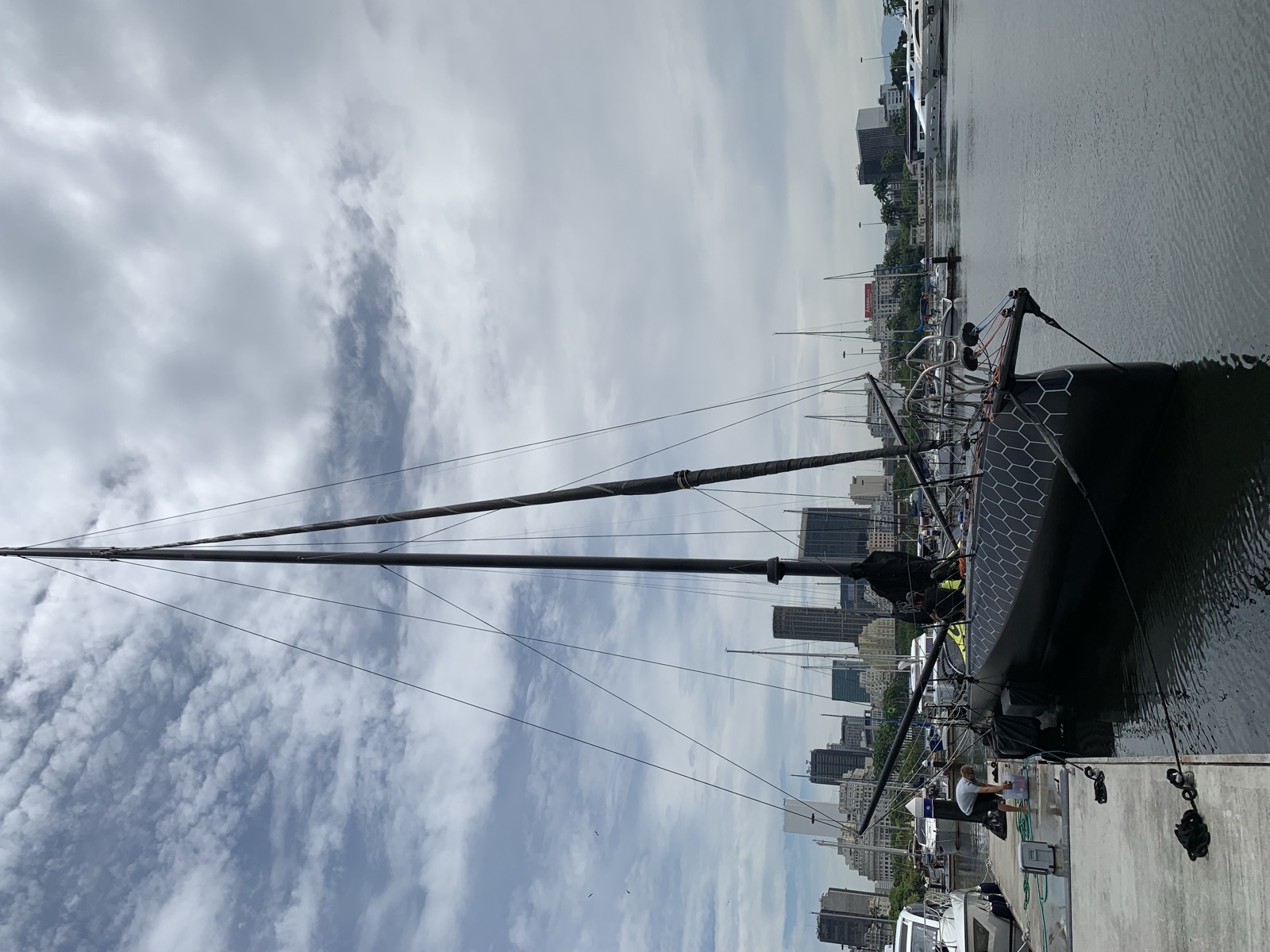
You notice a boat like that immediately. Long, low, impossibly slender. A matte black carbon hull covered in a geometric hexagonal pattern, like the skin of some deep-sea creature. A single mast that seemed to go up forever. Neon yellow accents on the foils. No fenders out, no crew on the bow — just two people and a boat that looked like it had been designed by someone who had never heard the word "compromise."
We caught their lines and helped them dock. And as the man at the helm stepped ashore, we recognised him: Alex Thomson.
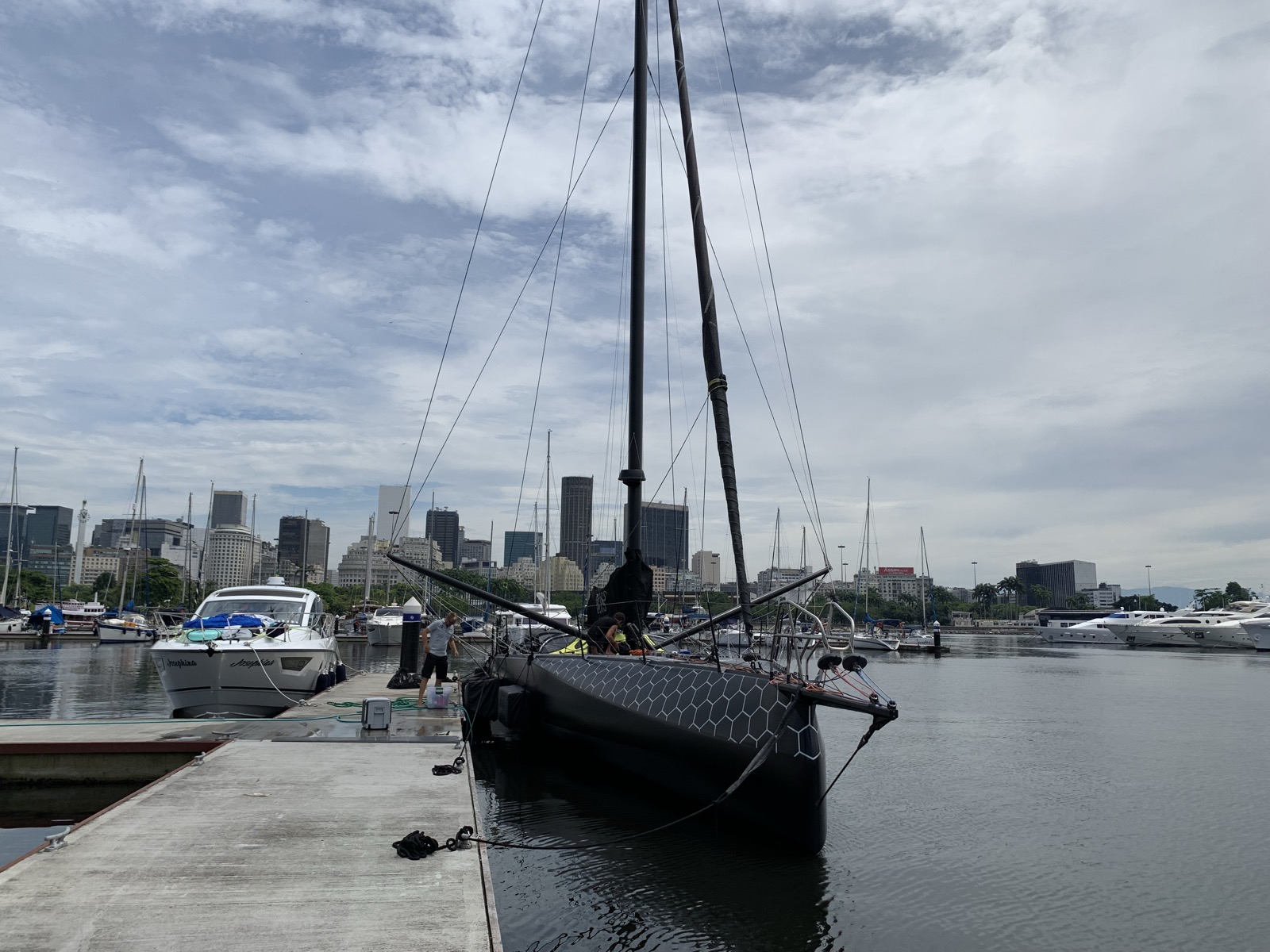
Hugo Boss at the dock — one of the most recognisable offshore racing yachts in the world, quietly moored next to Oroboro during Carnival
Who is Alex Thomson?
Alex Thomson is a British offshore sailor — arguably the most talented of his generation. He has raced the Vendée Globe more times than almost anyone alive. He finished second in 2016–17, losing to Armel Le Cléac'h by less than 16 hours after 74 days at sea and 24,000 miles — a defeat that came down to a damaged foil in the final stretch of the Southern Ocean.
The Vendée Globe is the sailing world's equivalent of the moon landing: solo, non-stop, around the three great capes — Good Hope, Leeuwin, Horn — in the fastest possible time. Modern Vendée Globe boats are IMOCA 60s: 60-foot foiling machines packed with onboard computers, satellite communications, and canting keels that allow the boat to generate almost impossible speeds by flying one hull clear of the water. The current record is 74 days. These are not boats you sail — they are vehicles you manage at the edge of what physics allows.
This is the polar opposite of the Golden Globe Race we had encountered just weeks earlier in the South Atlantic — a race run on 1968-era rules, where Istvan Kopar sailed 30,000 miles without GPS, with a wind vane for steering and a bucket to catch rainwater. Same ocean. Same three capes. Different universe.
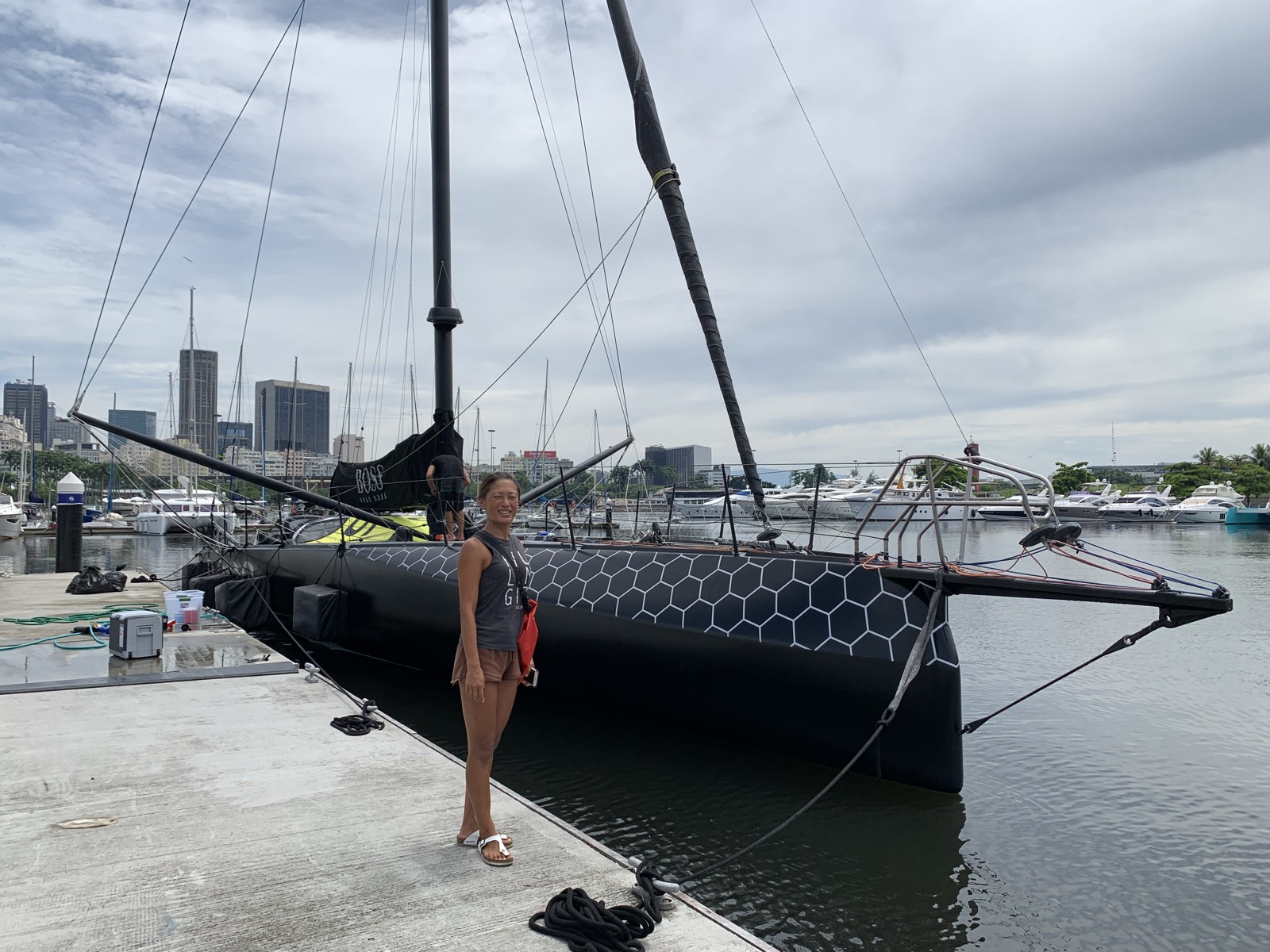
Yuka with the bow of Hugo Boss — the carbon hull and hexagonal deck pattern are unlike anything you see in a normal marina
A short detour
We talked for a while on the dock that evening. Alex was relaxed and generous with his time. He explained that he was delivering the boat to its new owner — just him and a friend, two people handling a solo racing yacht designed for one person at 30 knots in the Southern Ocean.
I asked where the delivery was going.
"Panama," he said.
I thought about that for a second. "If you came from Gibraltar, that's not exactly the direct route to Panama."
He grinned. "I wanted to see Carnival."
"So you detoured through Rio de Janeiro for Carnival."
"Small detour."
Gibraltar to Rio de Janeiro is roughly 5,000 nautical miles. On a fast IMOCA 60, maybe ten days at sea. A "small detour." He said it the way you might say you took the scenic route through the park.
He was already planning the next chapter: a new Hugo Boss, a new foiling IMOCA 60 campaign, and the 2024 Vendée Globe. He would go on to make history in that campaign — after a brain tumour diagnosis in 2021, he recovered, returned to racing, and lined up at the start in Les Sables-d'Olonne in November 2024.
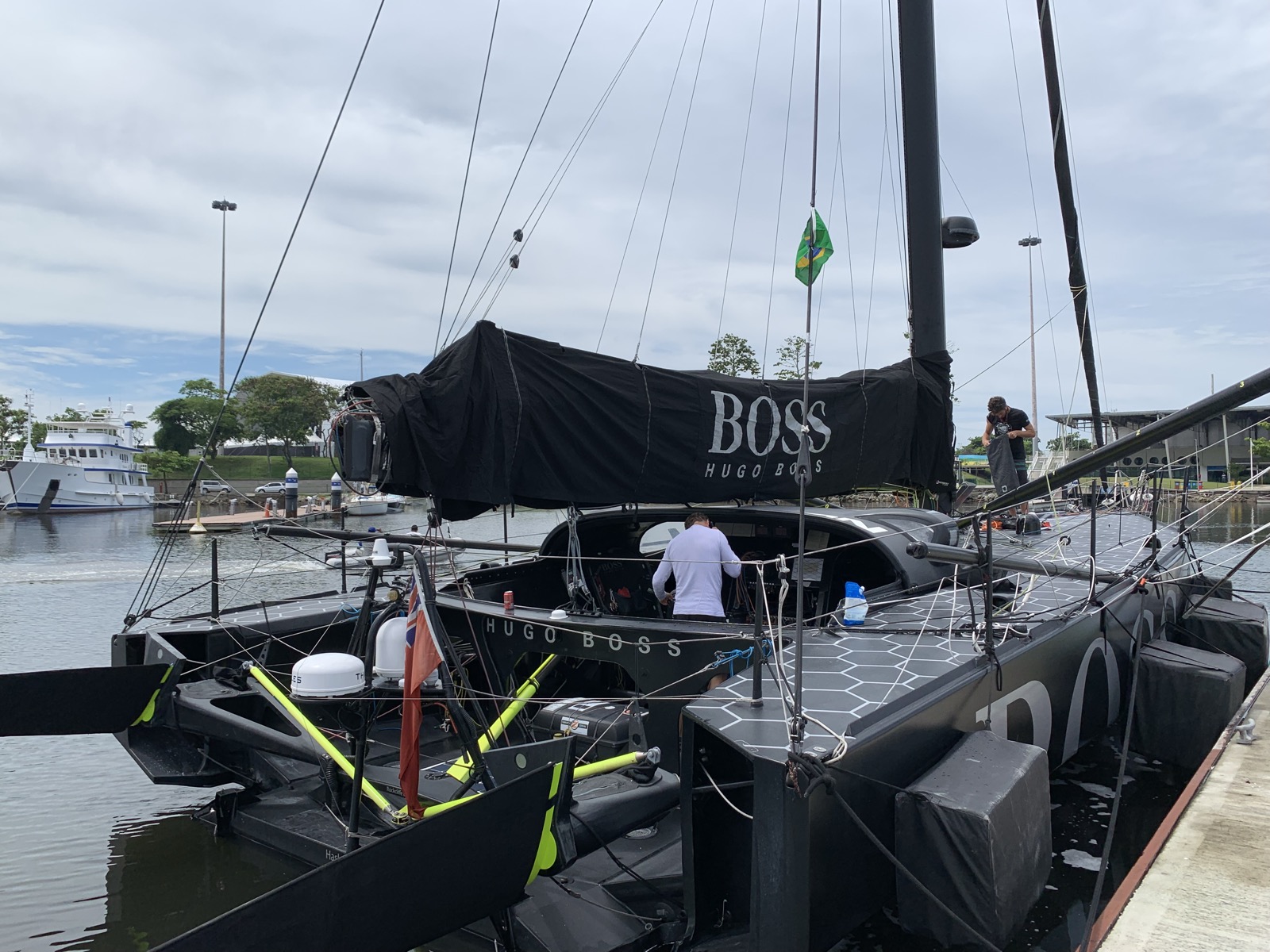
The stern of Hugo Boss flying a Brazilian courtesy flag — the boat had been racing and campaigning out of Portsmouth
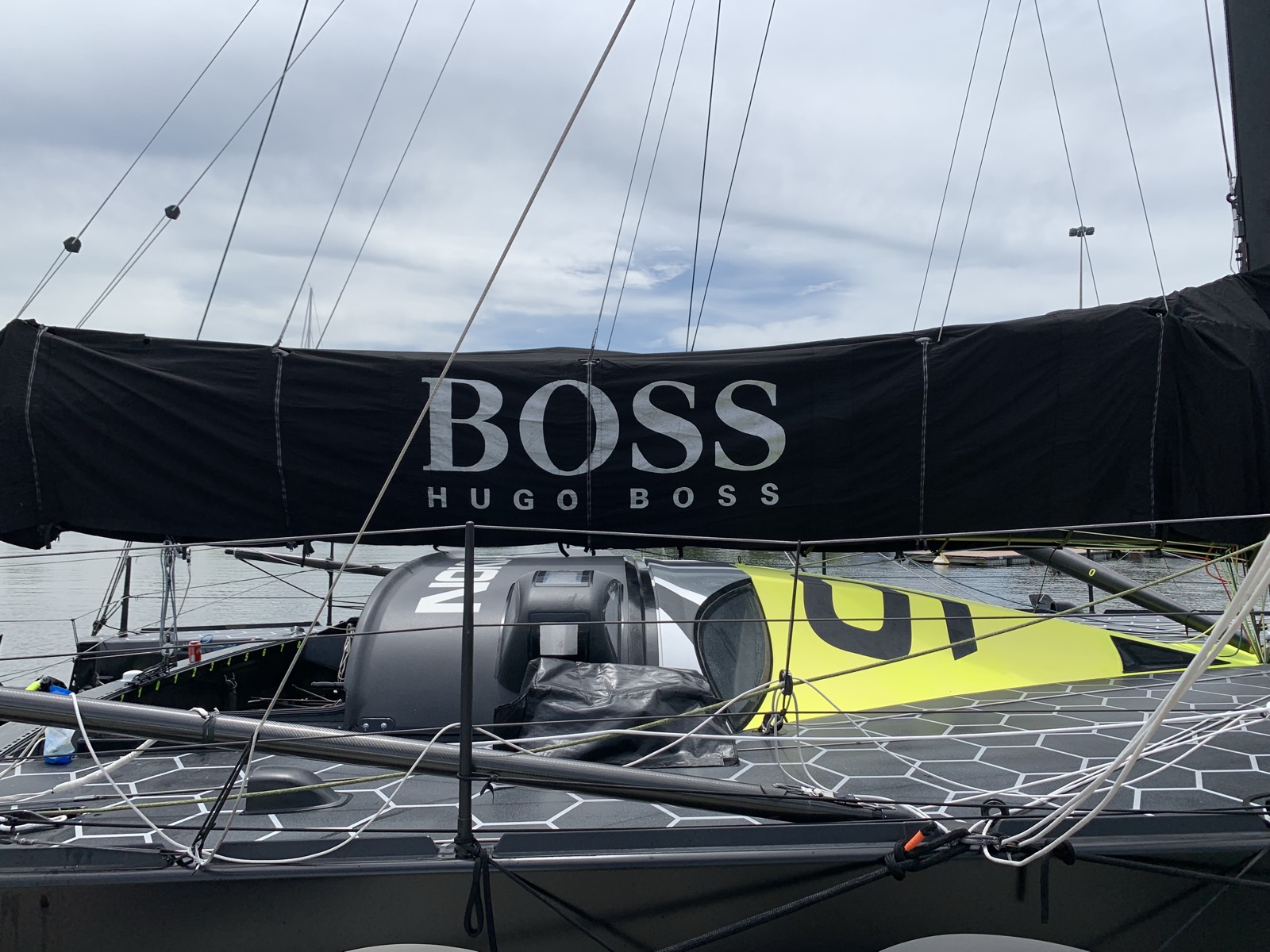
BOSS branding on the boom cover — the Hugo Boss sponsorship has been one of the longest and most visible in offshore racing
The boat
The next morning Alex invited us aboard for a look around. Up close, the boat is almost incomprehensibly specialised. Every surface is carbon fibre — mast, boom, hull, deck, the foil arms, the rudders. The cockpit is a single moulded pod with a few instrument screens and a minimal amount of rope. The salon below, if you can call it that, is a tube of carbon with a chart table and a survival pod. There is no galley worth speaking of, no berths, no comfort of any kind. The boat exists to go fast and to keep one person alive in the process.
Starboard side showing the foil arm housing — when deployed, the foils lift the bow clear of the water at 20+ knots
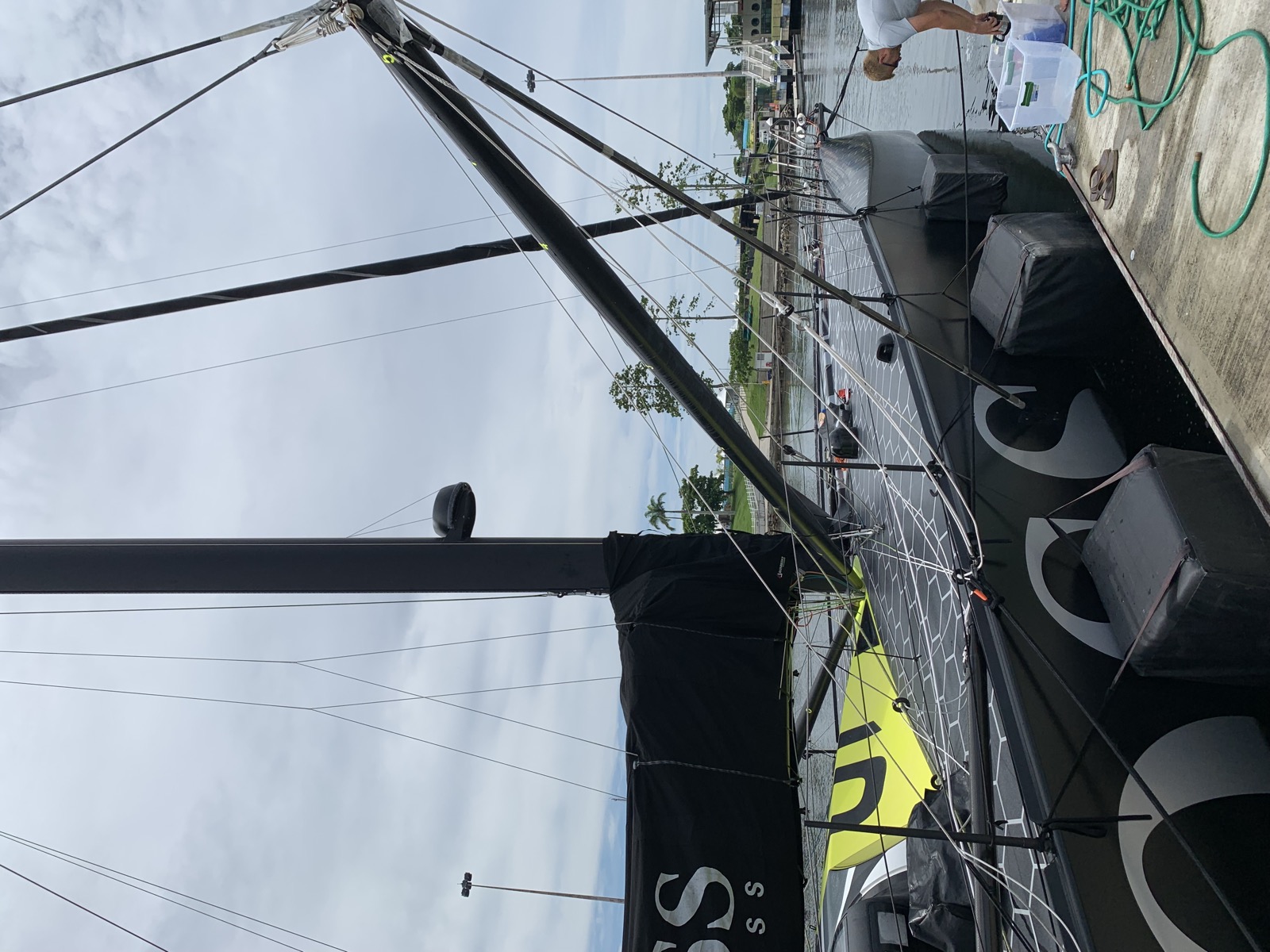
The port side hull from dock level — the mast rises 29 metres above the waterline
Looking up the carbon mast from the bow — 29 metres of free-standing spar built to survive the Southern Ocean
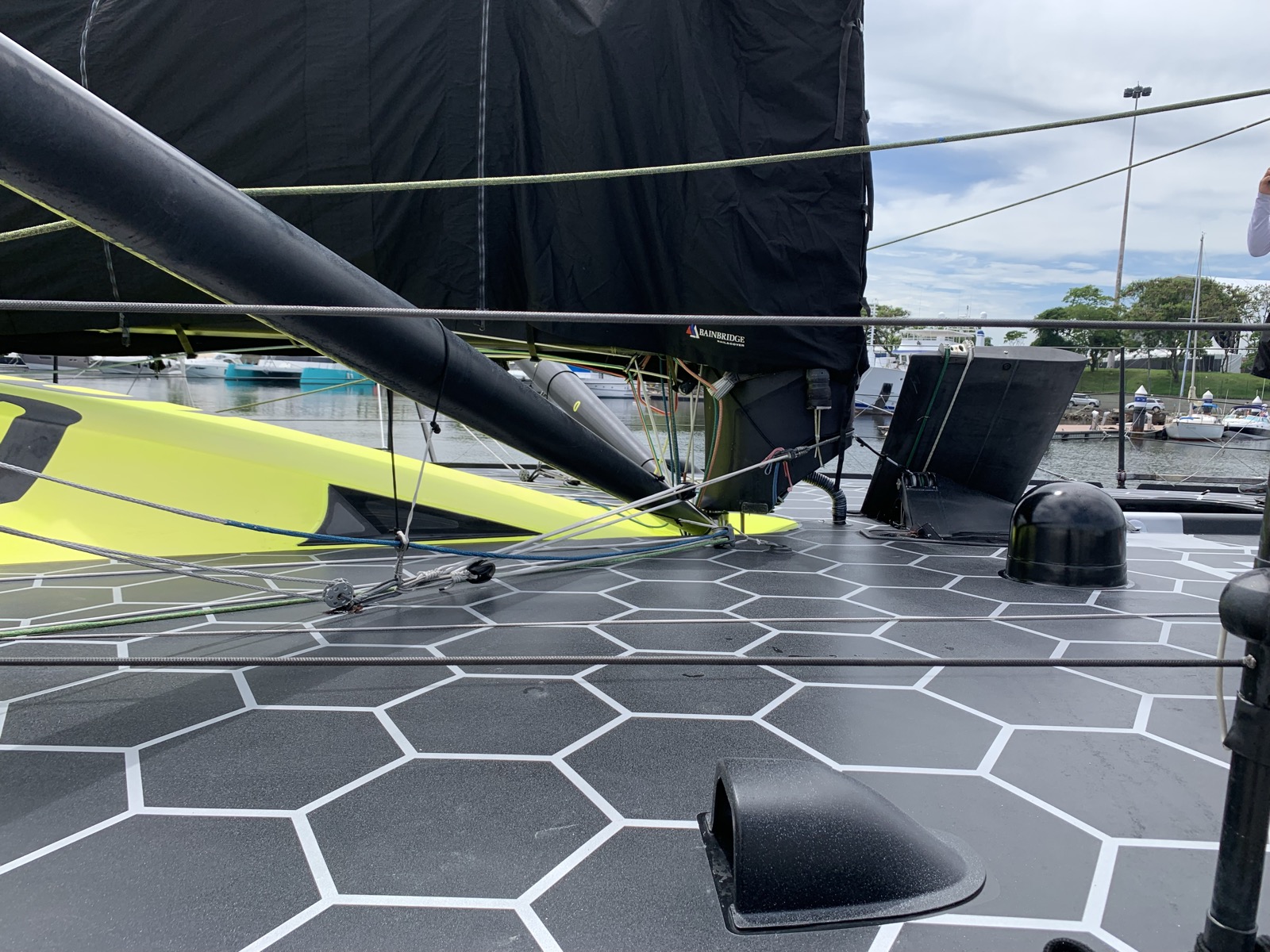
Looking aft along the deck — the honeycomb non-slip surface, canting keel ram, and furled yellow gennaker
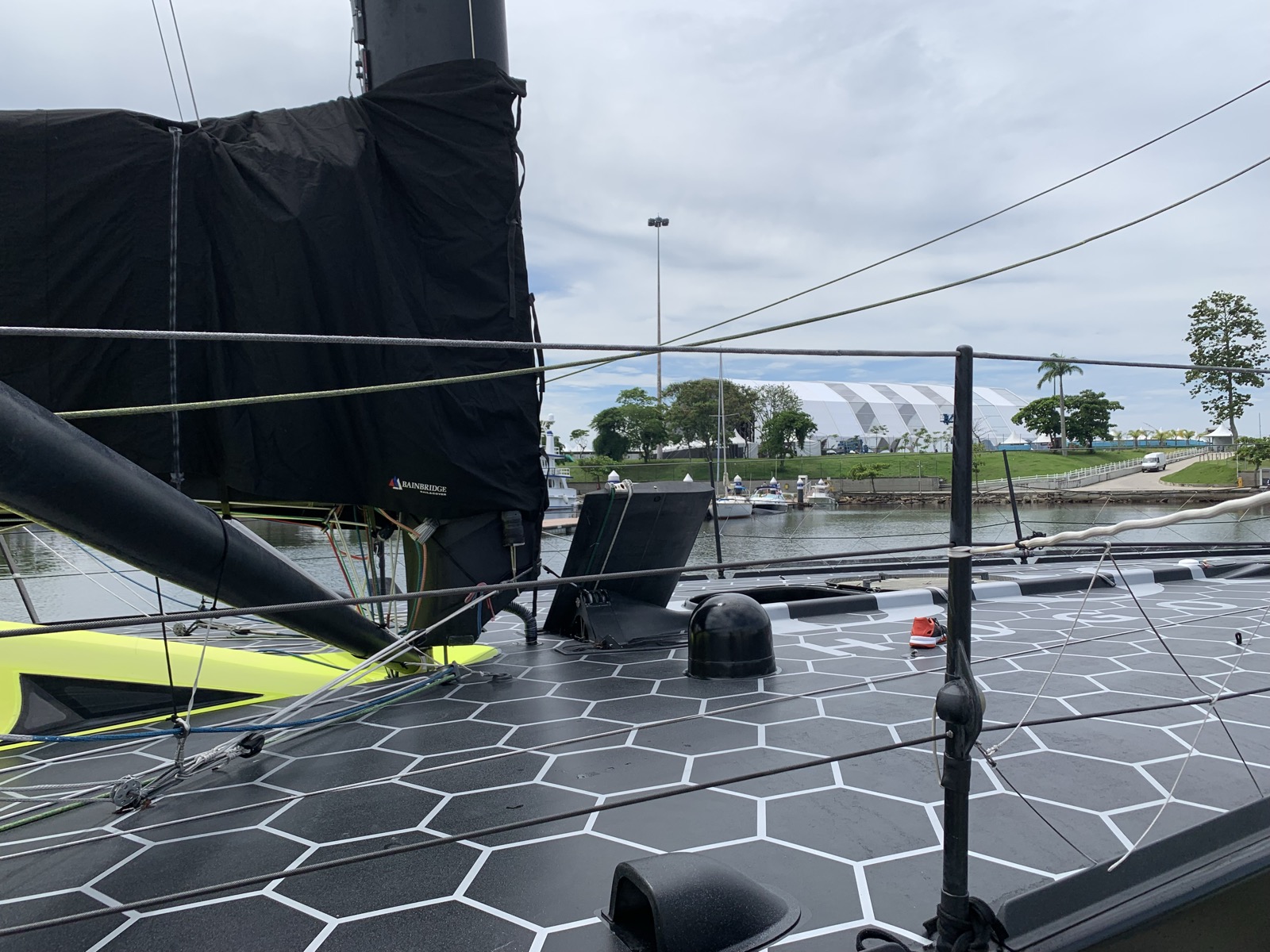
Looking aft toward the cockpit pod — the instrument dome and minimal steering position of a solo offshore racer
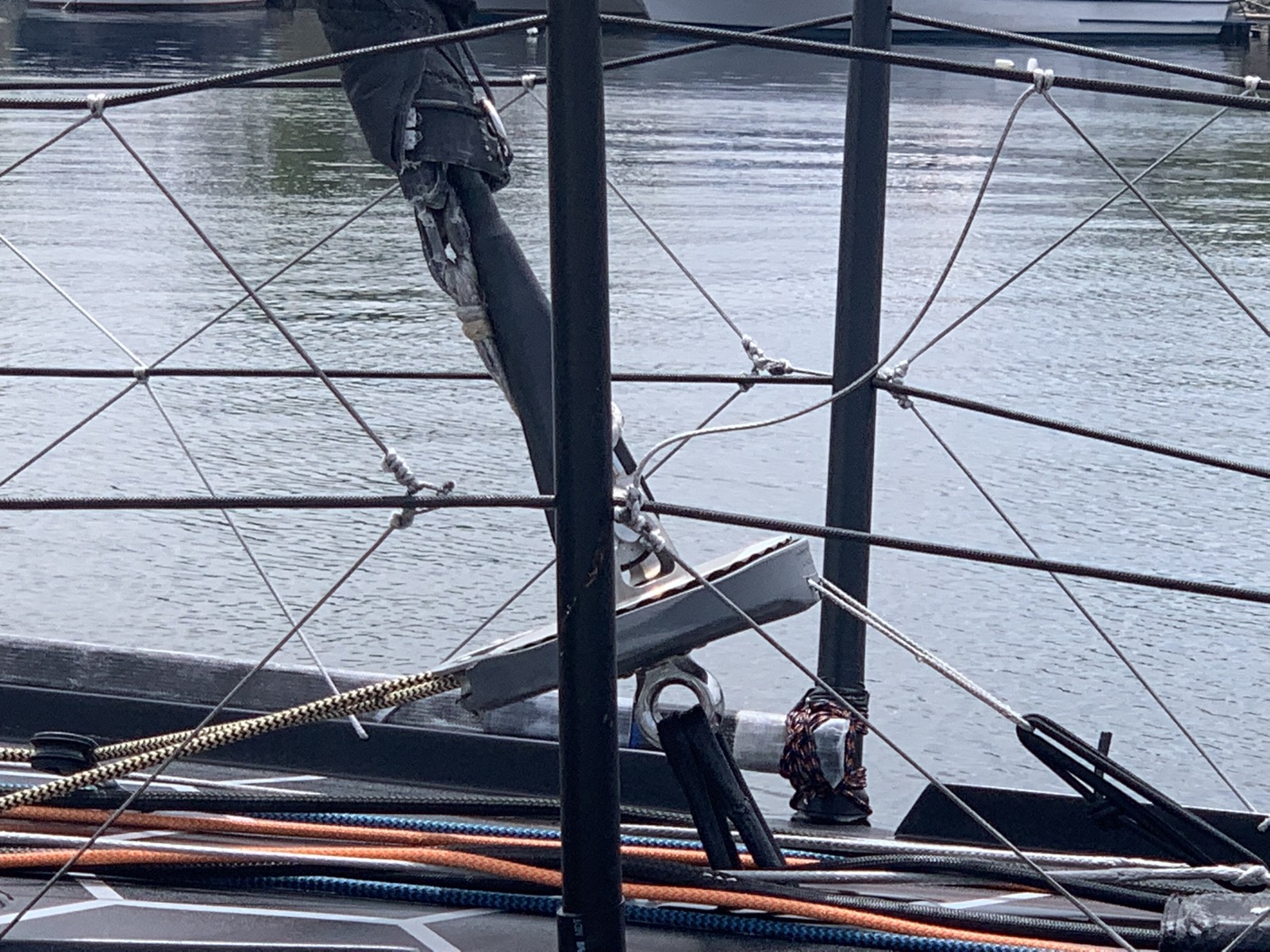
Carbon hardware at the mast base — every component on this boat is custom-engineered for one purpose
The stunts
As well as being one of the best offshore sailors in the world, Alex Thomson is also something of a showman. The Hugo Boss campaign has produced some of the most spectacular sailing promotional videos ever made — videos that went far beyond the usual sailing media and into mainstream culture with tens of millions of views.
In the Keel Walk, dressed in a suit, Alex runs along the fully submerged keel of Hugo Boss while the boat sails at over 20 knots with the hull heeled to 90 degrees. The keel — a 4-metre steel fin with a lead bulb at the bottom — is normally a metre below the waterline. In the video it is horizontal, Alex is vertical on it, and the boat is doing what IMOCA 60s do. It is one of the most surreal images in sailing.
The Keel Walk — Alex Thomson runs along the submerged keel at 20 knots — and the Skywalk, where he stands at the 29-metre masthead under sail
The Skywalk is the other. Alex climbs to the top of the 29-metre mast while Hugo Boss sails at speed — standing at the masthead with the boat rolling and the top of the rig describing a wide arc through the air. It is not a stunt that appears on any ISAF-approved safety checklist.
There is something about these videos that captures exactly why Alex Thomson is different. He is a serious, technically brilliant offshore sailor — one of the few who can genuinely challenge for the Vendée Globe. But he also understands that sailing needs an audience, and that sometimes the best way to explain what these boats are capable of is to do something with them that makes your stomach drop.
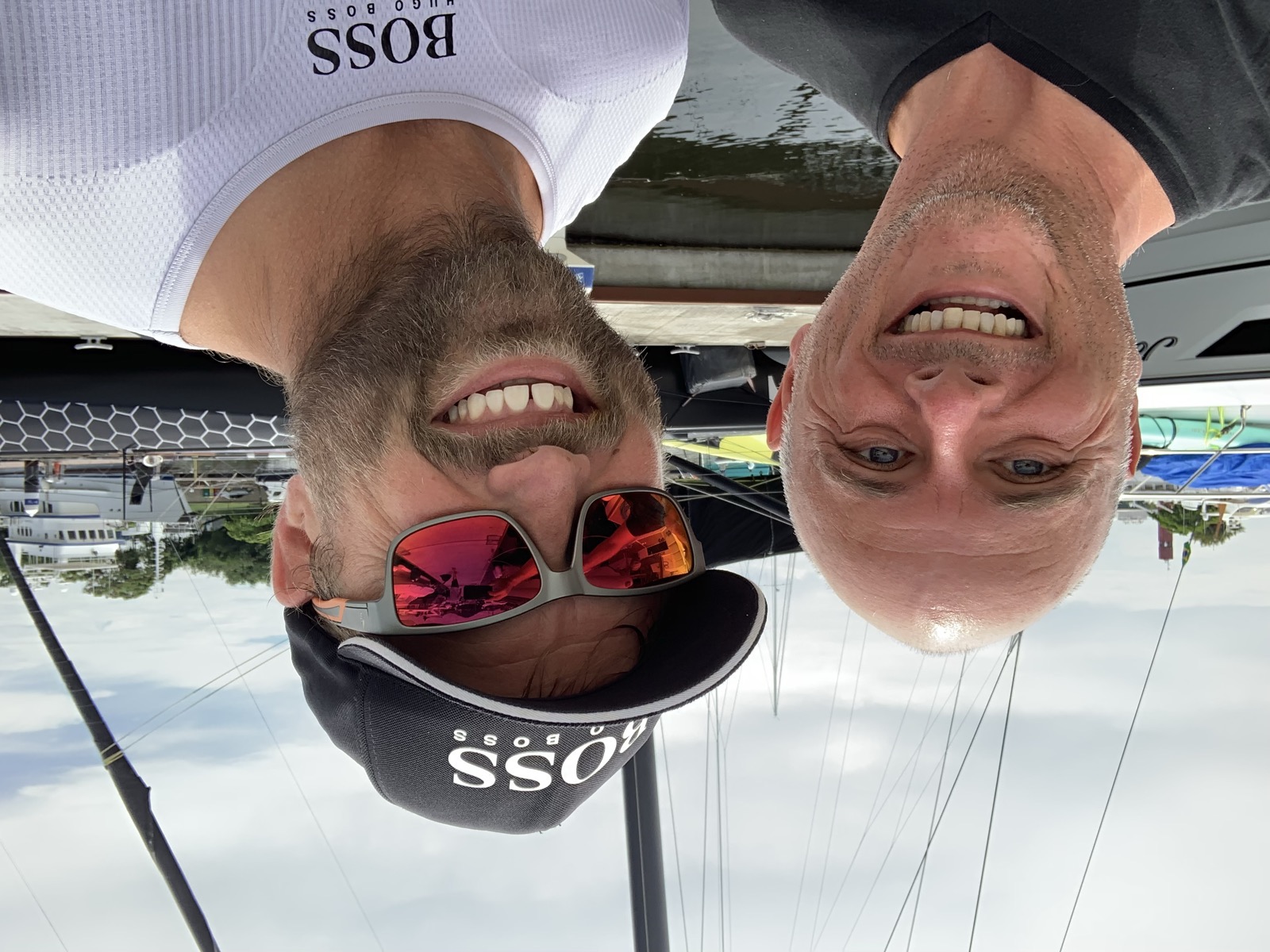
With Alex Thomson aboard Hugo Boss — one of those mornings you don't plan and don't forget
We visited again over the following days, and Alex let us take a proper look around the interior. Everything on this boat is purpose-built to a degree that makes most other sailing yachts look like they were designed by committee.
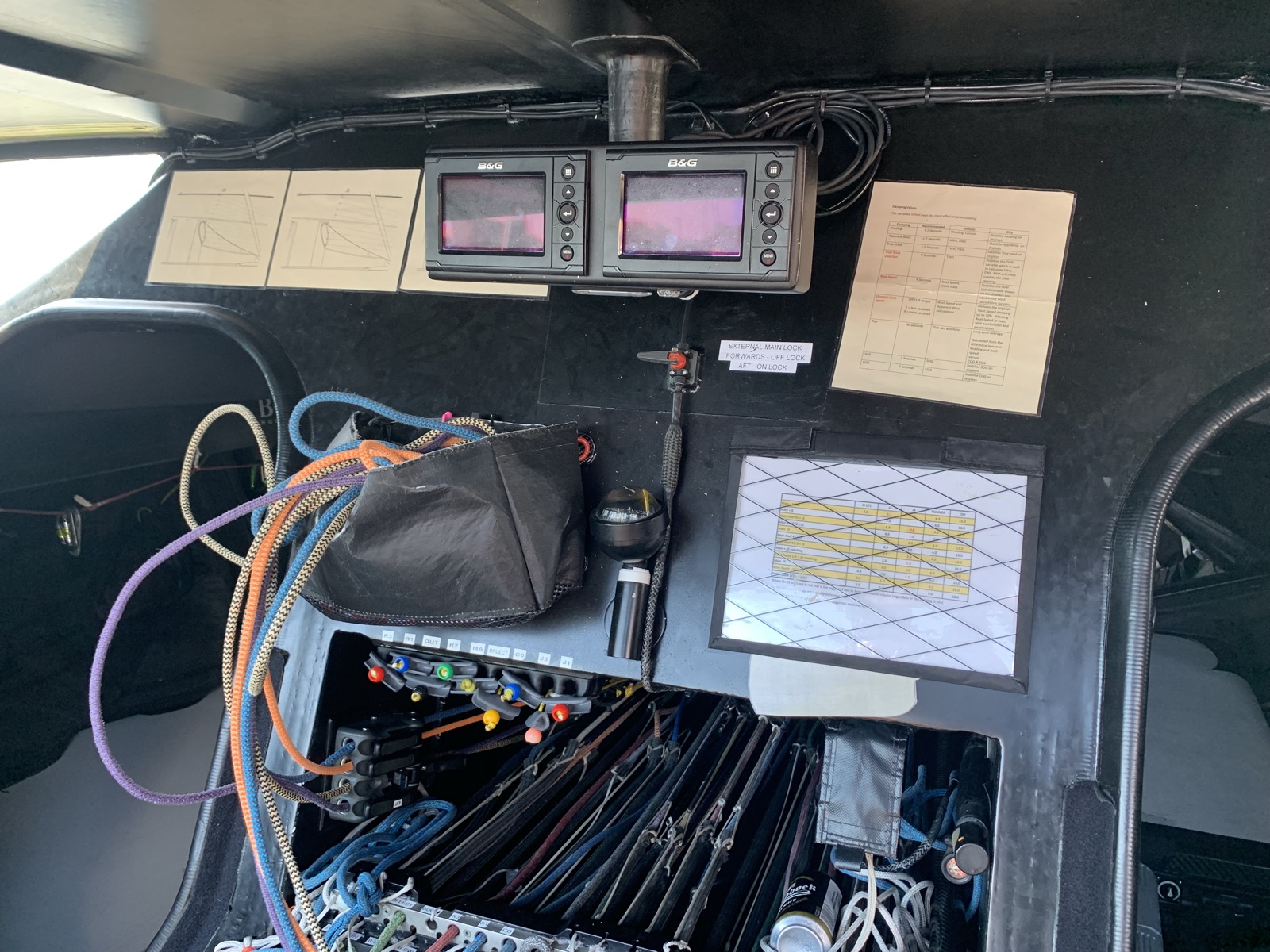
The cockpit navigation station — dual B&G chart plotters, damping-value reference sheets taped to the bulkhead, and custom race hardware
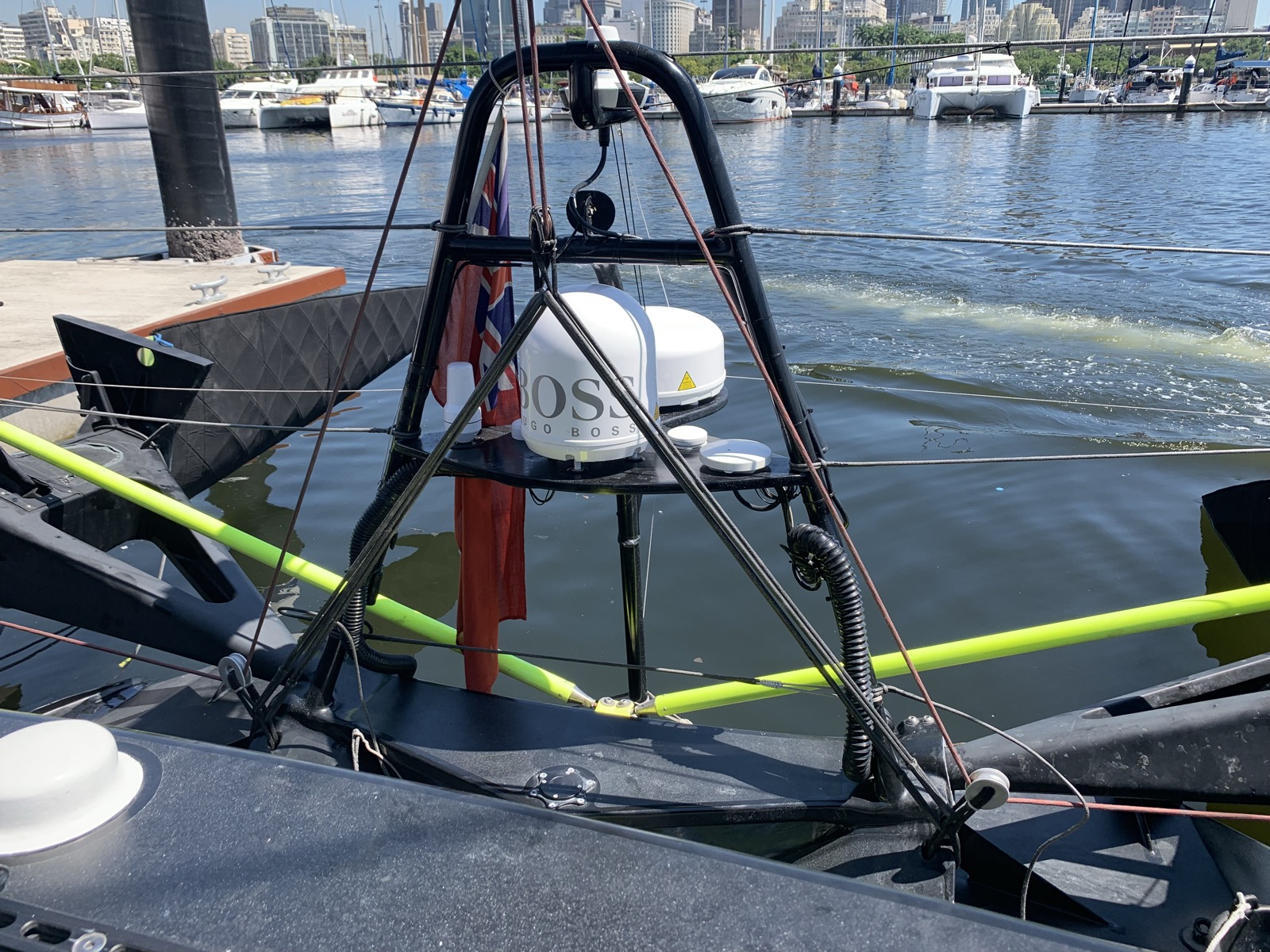
The forward section from the dock — the BOSS satellite dome, starboard foil arm, and neon yellow tether lines
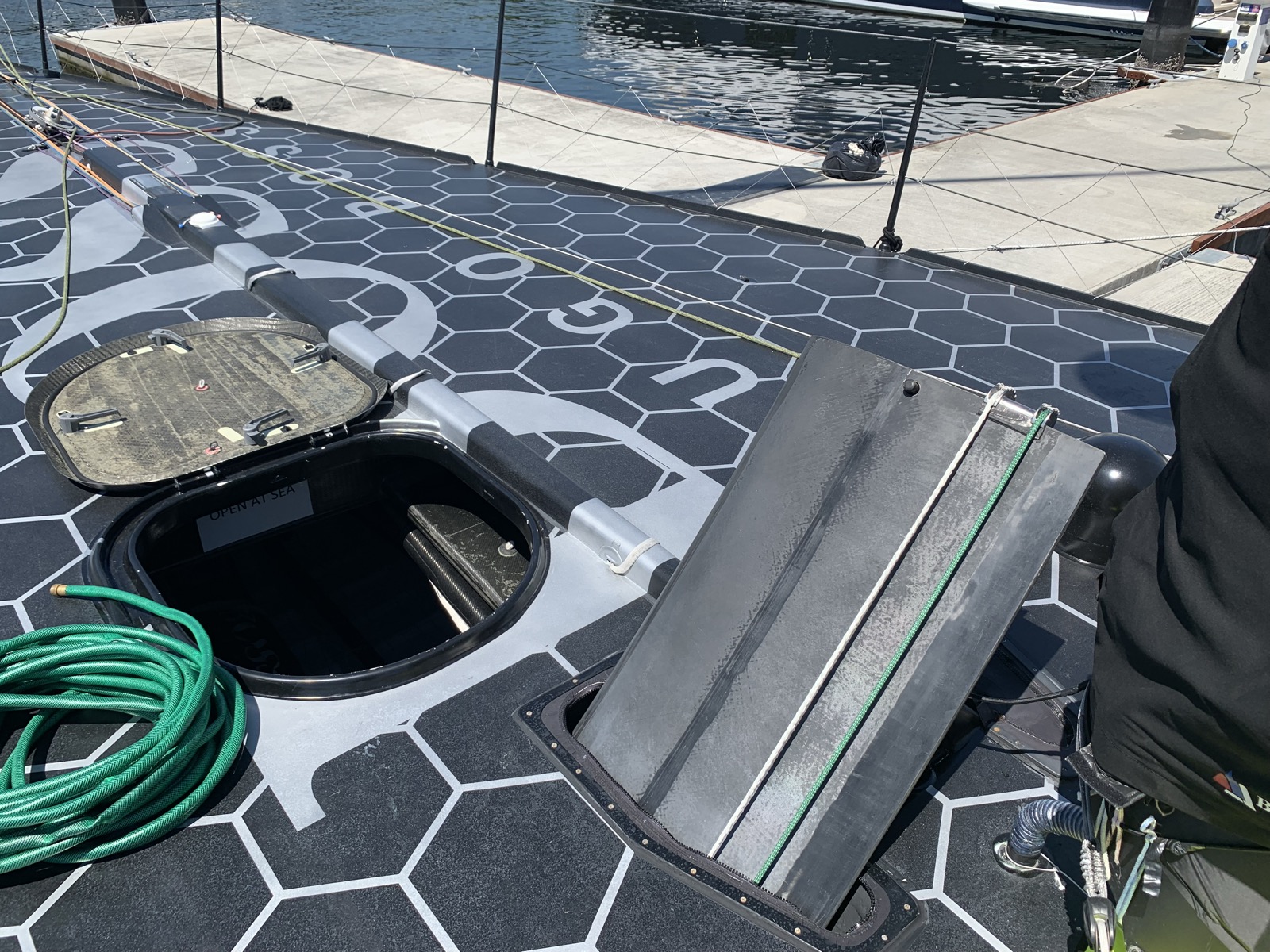
The distinctive hexagonal grip pattern that covers the deck — non-slip carbon fibre, unmistakably Hugo Boss
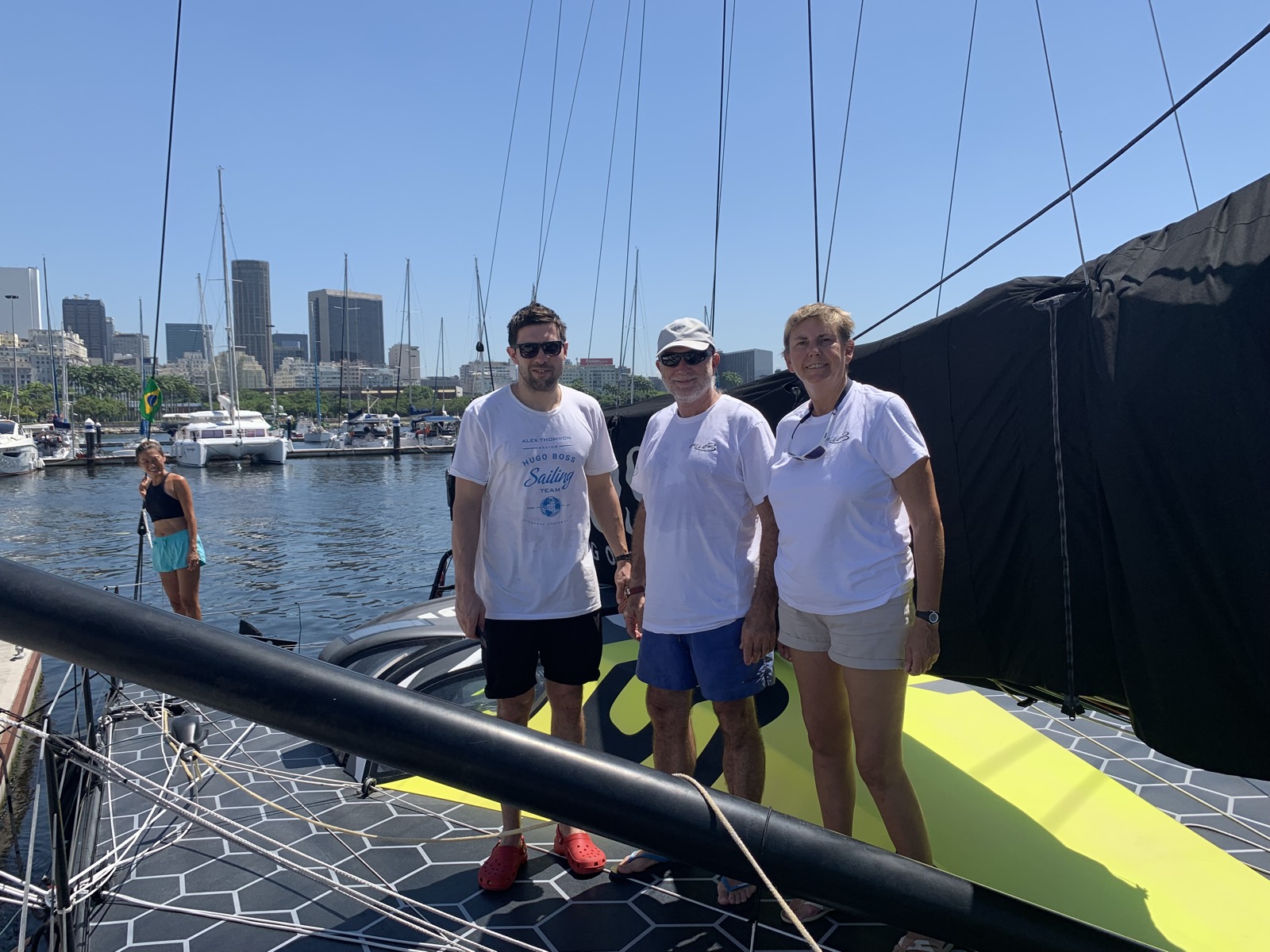
With Joaquin and Monica on the deck of Hugo Boss — Alex generously gave us the team shirts before we left
Walking the deck of Hugo Boss — from the bow past the foil arms and instrument dome, back to the minimal cockpit pod where a solo sailor manages 28,000 miles of ocean
More than 500 astronauts have been to space. Fewer than 50 sailors have completed a solo non-stop circumnavigation. Alex Thomson has done it twice — and almost won it. We met him on a marina dock in Rio, where he had sailed a 60-foot ocean-racing machine 5,000 miles out of his way because he wanted to see Carnival.
Some detour.